
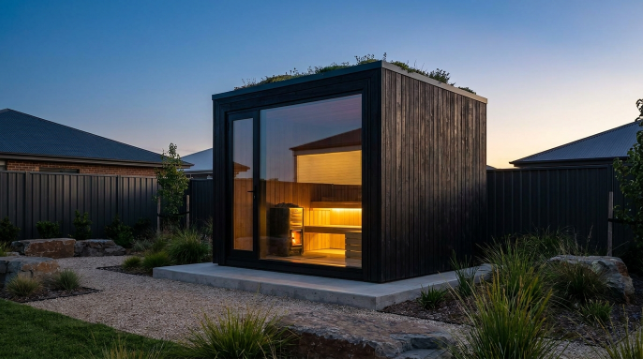
Whether to assemble a cube sauna yourself or pay for professional installation comes down to three things: whether you have a free weekend and a second set of hands, whether the electrical work needed is within your comfort zone to hire out separately, and how much your own time is worth against a typical installation labor cost. A panelized kit on a prepared pad usually takes two capable people one to two full days; a professional crew often finishes the same cabin in under a day, for a fee that reflects that speed and experience.
The Weekend DIYer: Two People, Basic Tools, a Free Saturday
This is the buyer a cube sauna kit is actually designed for. Panelized kits ship with pre-cut wall sections, a set of instructions, and hardware meant to be assembled with a drill, a level, and basic hand tools, no specialty equipment required beyond what a moderately handy household already owns. The realistic timeline is one to two full days for two people working together, since most wall panels are heavy and awkward enough that lifting and aligning them alone slows the process considerably and adds real risk of dropping or racking a panel out of square. This path saves the most money but demands the most time and physical effort, and it works best for someone who genuinely enjoys this kind of project rather than someone doing it purely to save on labor cost.
The Busy Professional: Short on Weekends, Comfortable Paying for Speed
For someone whose calendar does not have two consecutive free days, or who has done exactly one home project before and remembers it taking three times longer than expected, professional installation solves the actual problem rather than just the sauna problem. A crew experienced with cube sauna kits typically completes an install in under a day, sometimes a few hours, because they have done the specific sequence dozens of times and know where first-timers usually lose time. The added labor cost buys back a weekend and removes the risk of a panel going in slightly out of square, something that is much cheaper to prevent during assembly than to fix afterward. This path costs more upfront but is often the better value for anyone who would otherwise need to hire a handyman to fix DIY mistakes.
The Renter or Temporary-Yard Owner: Weighing Portability Against Permanence
Anyone unsure how long they will stay in their current home has a different calculation to make, since a cube sauna installed on a permanent foundation is a bigger commitment than one placed on a simpler removable pad or reinforced deck section. A DIY approach here has an advantage: someone who assembled the cabin themselves generally has a clearer sense of how it comes apart if a future move requires relocating it, though this is worth confirming against the specific model’s design before assuming disassembly is straightforward. A professional installer can still be the right call for the initial setup even in this scenario, since getting the pad and clearances right the first time matters regardless of how long the cabin stays in that spot.
The Electrical Work Is Its Own Decision, Regardless of Who Assembles the Cabin
This is the one piece of the project that should not be a DIY task for almost anyone, no matter how comfortable they are with the rest of the build. Most electric heaters sized for a four-person cube sauna need a dedicated 240-volt circuit, and that work should go to a licensed electrician regardless of whether the wood structure itself was assembled by a professional crew or by the homeowner over a weekend. Mixing these two decisions, DIY wood assembly paired with licensed electrical work, is a common and sensible middle path that keeps labor cost down where it is safe to do so while paying for expertise where it genuinely matters for safety and code compliance.
How Should You Actually Decide?
Start by being honest about the free time you actually have, not the free time you wish you had, since an assembly that stalls halfway through a weekend and sits half-finished for two weeks is a worse outcome than either full DIY or full professional install. Then get an actual installation quote before assuming it is out of budget; the gap between DIY and professional cost is sometimes smaller than expected once you account for tool purchases, potential mistakes, and the electrician’s fee that is required either way. Shoppers comparing what a specific retailer includes, kit-only versus installed pricing, can review a current listing from a specialty seller like SweatDecks to see how a four-person cube sauna is typically priced and what installation options, if any, come attached to the listing.
Does the Assembly Method Affect How Well the Sauna Performs Long-Term?
Not if the work is done correctly either way, though a rushed DIY assembly is more likely to leave small gaps or misaligned panels that cost efficiency over time, showing up as a heater that runs longer than it should to hold temperature. The broader research on regular sauna use, including a widely cited Finnish cohort study and a 2018 review in Mayo Clinic Proceedings, describes health associations tied to consistent use over years, which depends far more on whether a household actually keeps using the cabin than on who assembled it. A cabin installed well, whichever route got it there, and used consistently is the pattern the research actually describes.
What Tools Should a DIY Buyer Have Ready Before Assembly Day?
Most panel kits call for a cordless drill with spare batteries, a four-foot level, a rubber mallet, a socket set matching the supplied hardware, and a helper who can commit a full day without other plans. A ladder is worth having on hand for roof panel work even on a single-story cube design, and a second person holding a panel steady while the other drives fasteners cuts assembly time far more than most first-timers expect. None of this is specialty equipment, which is part of why the kit format works for a reasonably handy household, but showing up without a level or without a second person is the most common reason a one-day job stretches into two.
Frequently Asked Questions
Can one person assemble a cube sauna kit alone? Most panelized kits are designed for two people to lift and align wall sections safely. A single strong, patient person can sometimes manage smaller pieces, but planning for a second set of hands makes assembly day smoother and safer.
How long does a DIY cube sauna assembly typically take? A prebuilt panel kit on a prepared, level pad commonly takes one to two full days for two capable people, not counting the separate electrical work, which should go to a licensed electrician regardless.
Does a DIY install ever void the warranty? Assembly itself usually does not, since kits are designed for owner assembly, but improper electrical work performed by anyone other than a licensed electrician commonly does. Read the specific terms before starting.
Is professional installation worth the extra cost for most buyers? For anyone without a free weekend, a second set of hands, or comfort with basic tools, yes. The labor cost is real, but so is the time and risk of a mis-assembled cabin.
References
- Association between sauna bathing and fatal cardiovascular and all-cause mortality events, JAMA Internal Medicine, 2015
- Benefits and risks of sauna bathing, The American Journal of Medicine, 2001
- Clinical Effects of Regular Dry Sauna Bathing: A Systematic Review, Evidence-Based Complementary and Alternative Medicine, 2018
By Travis Nadeau